

The PHEND project
In 2022, Rue des Chantres (Erwan Picquet, Vincent Pislar, Christian Ploix and Renaud Tripathi) participated in a University research project on acoustics in Notre-Dame through the centuries in connection with the reconstruction of the cathedral. This is the Project PHE (the Past Has Ears) and more specifically its French component PHEND (the Past Has Ears at Notre-Dame), either « The Past Has Ears at Notre-Dame ». He is led by Brian Katz. This European virtual acoustic reconstruction project was born after UNESCO expanded the concept of cultural heritage to sound in 2017-2018, whereas until then only tangible and visual objects were concerned. Lacoustic heritage is now part of the Intangible Cultural Heritage of Humanity. Now, since the 2019 fire, the acoustics of Notre-Dame de Paris is more than just a memory... to reconstruct.
Severals moments important of the History du monument will be highlighted. The purpose of thistot Virtual acoustic reconstruction, In addition to testing the techniques used immediately, is constitute later help for researchers (historians, musicologists, architects) and for the general public. It will be possible to design immersive experiences in multiple forms, in museums or in smartphone applications.
Taking into account architectural peculiaritiesn and what is known about the materials that made it, lhe specialists can build a 3D acoustic model. Adding what they know on the propagation of sound in this place, it their is possible not only to make it visible but also audible. This is the process of« auralization » (process to recreate an acoustic environment from measured or simulated data). It is possible only if the sound Today who enters into the model is pure, Gross, without reverberation parasite. The actor or singer records his voice in an anechoic chamber, then he is filmed and his image is placed in the visual model, and finally his voice is introduced with variations depending on the position of the speaker in relation to the play and in relation to the auditor.
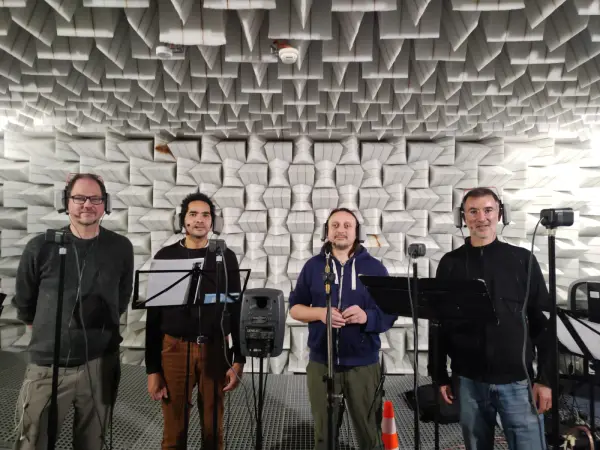
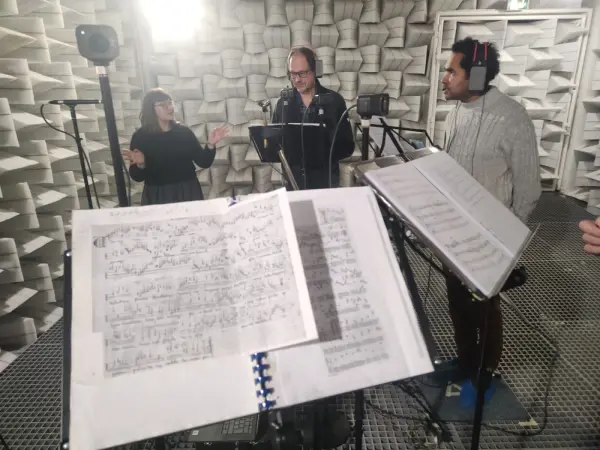
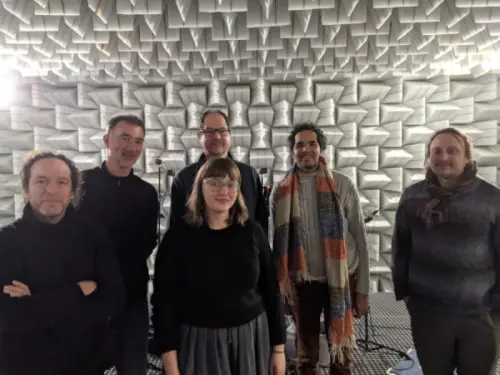
The singers have so recorded their voices in an anechoic chamber. One sound fiction was made from thist registration by producer « Narrative », entitled A la Recherche de Notre-Dame. Lhe authors imagined that Victor Hugo, wanting to write his novel Notre-Dame de Paris in 1828, went in search of information on the history of the cathedral through not time or space but through sounds. We hear ons four singers in the 13th century section interpreting the famous notes of Viderunt omnes Perotin, in an acoustic that was close to what could be heard at the time.
To discover the experience of Rue des Chantres
To follow the show!
Fin January 2023, a new recording session took place, in the presence of PhD student Sarabeth Mullins and her thesis director Brian Katz, LAM (Lutheries – Acoustics- Music) of the Institut Jean le Rond d'Alembert, Sorbonne University, CNRS.
On March 3, 2023, an article by Madeleine Schwartz on the PHEND project published in The New York Times online allowed Americans in love with the cathedral to hear the voices of Rue des Chantres from home thanks to an online preview of a first state of modelling.
Extract from article: « To test the acoustics of the space at different points in the cathedral Pérotin was part of the Notre-Dame school of composition, which developed contemporaryly with the building of the cathedral in the 12th and 13th centuries. The Notre-Dame school was polyphonic, and in an organum like the ‘Viderunt,' you might hear a song with more colorful upper voices, florid moments that illuminate the prayer, like golden margins on a piece of vendum. (...)To understand the interplay between the song and the historical acoustics, the group bought in experienced medieval songs to perform in an echo-free chamber. They have been testing the ornate lines of ‘Viderunt Omnes' in relation to the complex acoustics of the vaulted cathedral, which at the time of the song » (« A Cathedral of Sound »by Madeleine Schwartz, The New York Times3 March 2023).
Scroll the mouse!
LATIN PARADIS
Fruit of a meeting with the sisters Melissa and Ophelia Hié in 2021
On March 11, 2021, Rue des Chantres makes a video with the sisters Mélissa and Ophélia Hié, two highly talented Bordeaux women who forget neither their roots in Burkina Faso nor their European urban experience in their percussion duo. Take the time to listen to the results of their exchanges named Latin Paradise, which will make you enter a Western and African double trance where the common memories of the peoples are mixed in a communicative interaction. The songs from Montserrat's Vermeil Book take on another color with this pair of balafons.